


 marketing@expomax.com.cn





R2 Wireless SEG Light Box vs. Cabled Frames: Setup Time, Failure Points and Maintenance Cost
Most buyers who search for a "wireless" light box assume it means app control or Bluetooth. It doesn't. In a wireless SEG frame, the word describes exactly one thing: how power moves from one frame section to the next.
In a conventional cabled frame, that job is done by short jumper cables linking the LED bars. In a wireless frame, the conductors sit inside the 120mm profile and the connection is made when two sections meet. Nothing dangles, nothing has to be plugged in by hand, and nothing can be left behind in the case.
That single design decision changes the three numbers that decide whether a display system is worth owning: how long it takes to build, how often it fails on site, and what it costs to keep running over twenty shows. This article works through all three, then shows how the R2 Wireless SEG Light Box is built around each one.
1. What "Wireless" Actually Means in a Wireless SEG Light Box
Two separate things are happening at every joint, and buyers usually conflate them.
Mechanical Connection: Integrated Locking Pins
Mechanically, the sections lock together with spring-loaded pins set into the profile — the integrated button system that locks and releases each joint. Because the pins sit inside the extrusion rather than protruding from it, there is nothing sharp to catch a hand during assembly, and no loose fitting to lose. Assembly is tool-free: no hex key, no screwdriver, no drill.
Electrical Connection: Internal Conductors
Electrically, current is carried through conductors built into the profile, with the connection completed at the joint and fed up the wall by a vertical power pole. This is the part that removes jumper cables from the build.
To be precise about what this is not: a wireless SEG light box does not transmit power through the air, and it is not a smart display. It is a frame in which the wiring is internal and the connection is structural. The benefit is reliability and speed, not connectivity.
That distinction also explains why the two R2 models behave differently on site. The aluminum model (SEGQuick ULTRA 120mm, EM-18FBA) uses an all-aluminum extrusion with internal wiring and powder-coated finish. The PVC model (SEGQuick 120mm, EM-18FB) uses a PVC profile that is 100% non-conductive — a genuine safety argument on sites where the frame may be handled while powered circuits are nearby. Same modular logic, different material trade-off.
| Feature | R2 Aluminum (EM-18FBA) | R2 PVC (EM-18FB) |
|---|---|---|
| Profile | 120mm aluminum extrusion | 120mm PVC profile |
| Electrical design | Internal wiring | Internal connection system |
| Material property | 100% aluminum | 100% non-conductive PVC |
| Surface finish | Powder-coated pearl white | Textured PVC finish |
| Assembly | Tool-free, 1m modules | Tool-free, 1m modules |
2. Setup Time: Where the Minutes Actually Go
Frame assembly takes roughly the same time either way. The difference sits in everything that happens after the frame is standing.
A working model: a 10 ft × 8 ft backwall built from 1 m modules, around 12 frame joints, five LED bars, one power entry, two installers. Substitute your own labor rate — the ratio matters more than the absolute numbers.
| Build Step | Cabled Frame | Wireless Frame |
|---|---|---|
| Frame assembly | 18 min | 18 min |
| Routing cable through channels | 6–9 min | 0 |
| Seating connectors (8–12 points) | 4–5 min | 0 |
| Power-on test and re-seating faults | 3–6 min | 1 min |
| Repack (coil cables, count jumpers) | 4–5 min | 2 min |
| Total | 35–43 min | 21 min |
The delta is roughly 15–22 minutes per build, and it compounds: over twenty shows, five to seven hours of labor. At $65/hour that is $325–$455 per wall per year — not transformative on its own. The real return is schedule. A crew that finishes twenty minutes early has twenty minutes for the thing that actually went wrong that morning.
Expomax specifies around 10 minutes for a standard 120mm PVCunit assembled tool-free by an experienced pair. That figure assumes a single panel; a multi-panel wall scales with the number of joints, not with the frame technology.
Note: The comparison above is an illustrative working model based on the stated assumptions, not a guaranteed installation time. Actual results depend on wall configuration, crew experience, and site conditions.
3. Failure Points: Five Places Cabled Frames Fail
Cabled systems don't fail randomly. They fail in the same five places, roughly in this order of frequency.
| # | Failure | What It Looks Like on Site | Why It Happens |
|---|---|---|---|
| 1 | Missing jumper | One panel stays dark | Cable left in the previous case, or never packed |
| 2 | Bent or recessed pin | Flicker or dead bar at a seam | Connector forced in at an angle under time pressure |
| 3 | Pinched cable | Intermittent contact that worsens after transport | Cable trapped when a joint is closed |
| 4 | Damaged lead in transit | Exposed conductor, fails venue inspection | Loose cable crushed against a hard case |
| 5 | Contact wear after repeated mating | Progressive flicker on older units | Connector cycled more times than it is rated for |
All five share one root cause: a part that lives outside the frame. A connection that is outside the frame can be left behind, pinched, crushed in a case, or mis-seated — and it tends to happen at exactly the wrong moment, which is the ten minutes before doors open.
Move the connection inside the profile and the first four failure modes largely disappear, because there is no separate part to manage. The fifth remains: contacts still wear. That is why the rated mating cycle count is a specification you should ask for, not a detail to assume.
4. Maintenance Cost: The 20-Show Math
Unit price is the least useful number in this comparison. What a distributor or stand builder needs is cost per show:
Cost Per Show
(Hardware + Graphics + Freight + Spares + Repair Labor + Storage) ÷ Expected Number of Shows
For a cabled system used twenty times, the line items that surprise people are spares and diagnosis:
Spares. Expect to hold 15–20% of your jumper count as replacements. Ten systems with five jumpers each means 8–10 spares in stock — plus the ones you lose rather than break.
Diagnosis time. A dark panel in a cabled wall can mean five possible faults. Tracing which one takes 10–20 minutes with the wall already up. In a wireless wall the same symptom usually resolves by reseating or swapping a single 1 m module — 3–5 minutes.
Warranty reality. Expomax's standard terms are three months on graphics and one year on hardware, parts and labor, excluding accident, abuse and normal wear. That is a normal commercial warranty for this category. It also means the wear items — connectors, jumpers, LED bars — are the owner's cost after year one, which is precisely where the two designs diverge.
None of this makes a cabled frame expensive to buy. It makes it expensive to run, and the cost lands on whoever does the running.
5. When Cabled Frames Are Still the Right Choice
Not every project should be wireless, and a supplier who says otherwise is selling rather than advising.
Cabled frames remain sensible when a wall is installed once and never moved, when the profile has to be a custom extrusion outside any standard range, or when the display will be replaced within a season and the extra cabling cost never gets repaid.
The calculation flips as soon as a display is built more than a handful of times a year. That is the point where setup minutes, spares and fault diagnosis start compounding against the buyer — and it is the point where a wireless frame stops being a premium and starts being the cheaper option.
6. How the R2 Wireless SEG Light Box Handles Each Failure Point
The R2 Wireless SEG Light Box was designed against those five failures rather than around them.
1. Internal Connections Reduce Loose Components
Connections live inside the profile. The locking pins are set into the extrusion and the power path runs internally, so there is no loose connector to lose and no protruding pin to bend in the case. Hands are protected during assembly because nothing sharp is exposed at the joint.
2. LED Covers Protect the Strip
LED covers over the strip. The PVC model uses decorative LED covers, and the aluminum model routes wiring internally. Either way the strip is not left exposed against the case — which is the usual cause of a dark band appearing after a few shows.
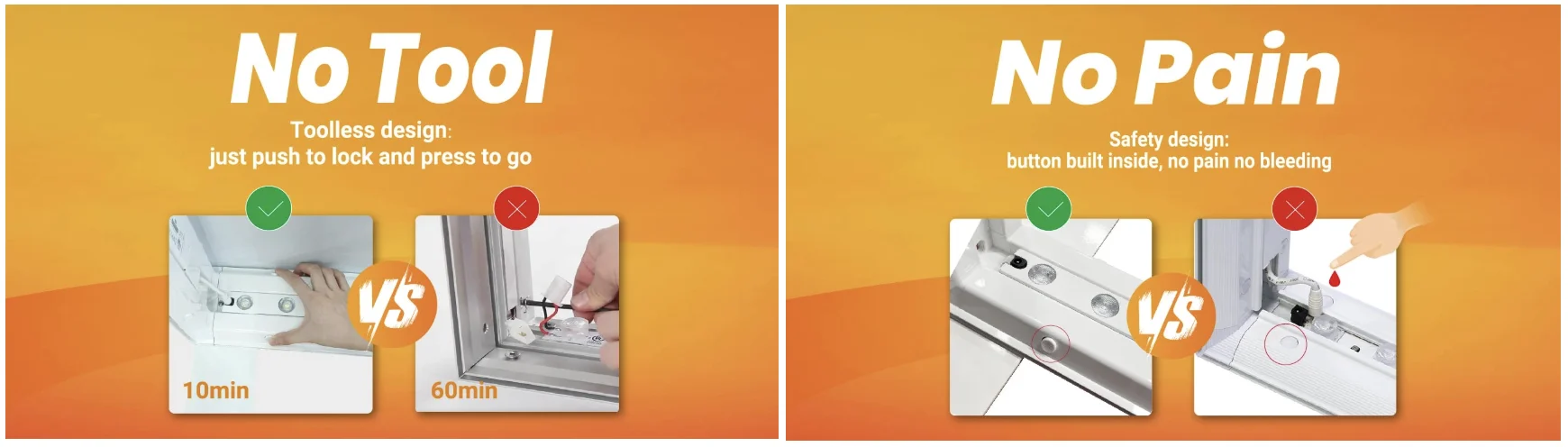
3. Tool-Free Assembly with an Integrated Button System
Joints are locked and released by pressing the buttons built into the profile rather than by tightening fasteners — which removes the loose-tool step, and the improvised force that usually comes with it.
4. One-Meter Modules Simplify Replacement
Because the system builds in 1 m increments, a failed section can be swapped without dismantling the wall, and a distributor can cover a wide size range from a small stock. The PVC model splices from 1 m to 6 m; the aluminum model runs from 33.47 in to 236.22 in wide.
5. Packaging That Matches the Logistics
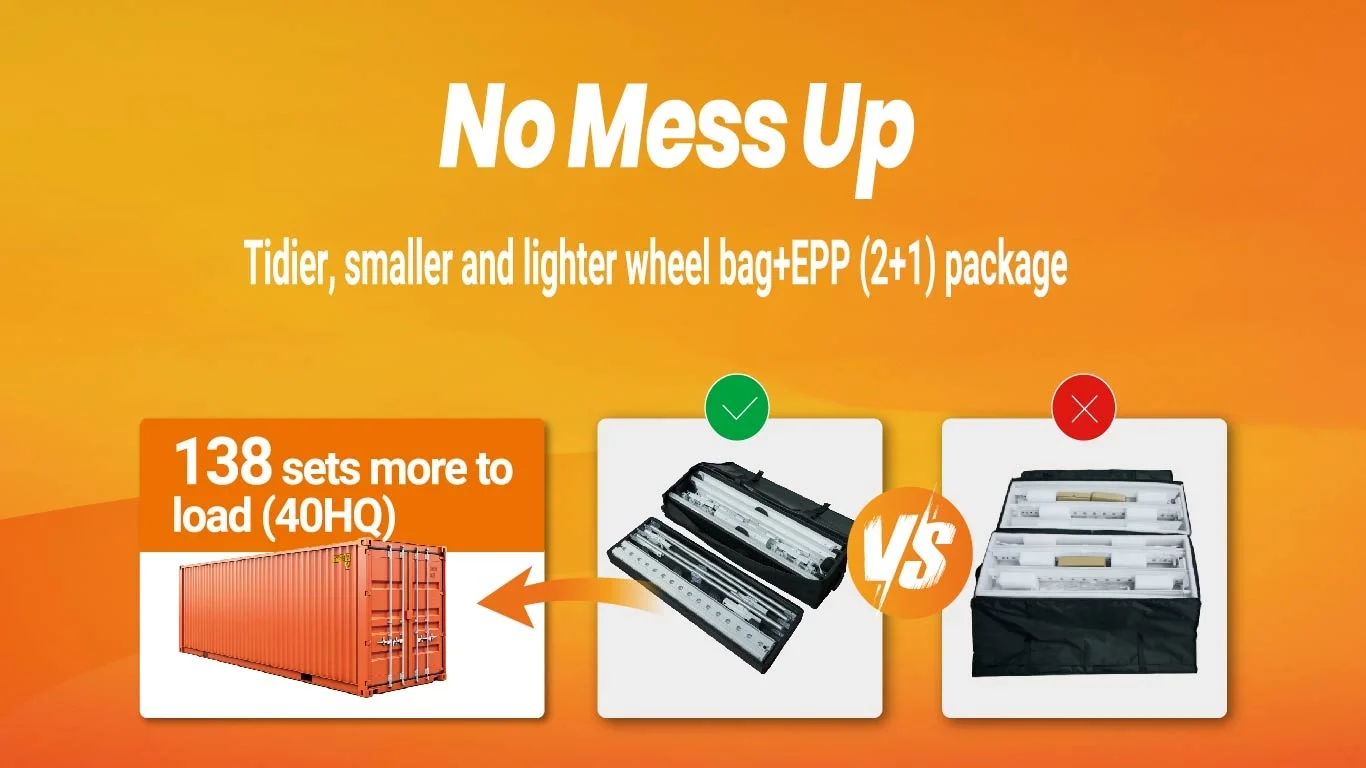
The aluminum model ships in compact EPP — durable, recyclable, and sized to cut shipping volume. On a 3 m × 2.4 m unit, Expomax quotes up to 138 more sets per 40 ft container than a standard aluminum 120mm lightbox. The PVC model uses a wheeled bag with EPP (2+1) packaging and quotes the same 138 additional sets per 40HQ against traditional solutions. For a distributor, that is the freight complaint answered in a number rather than an adjective.
6. Materials That Suit Different Sites
The aluminum R2 is 100% aluminum with a powder-coated pearl-white finish — the look of PVC without the PVC. The PVC R2 is a 100% non-conductive profile, which is the stronger safety story for venues where frames are handled near live circuits.
| Buyer Concern | R2 Design Response | Practical Benefit |
|---|---|---|
| Missing jumper cables | Internal electrical conductors | Fewer loose components to pack and manage |
| Damaged connection parts | Integrated connection structure | Reduced exposure during transport |
| Slow assembly | Tool-free integrated button system | Fewer manual connection steps |
| Replacement complexity | 1 m modular design | Individual sections can be replaced |
| Shipping volume | Compact EPP / wheeled bag packaging | More efficient packing and transportation |
| Electrical safety considerations | Non-conductive PVC option | Suitable material choice for relevant installation environments |
Looking for a Faster, More Reliable SEG Light Box System?
Compare the R2 Wireless SEG Light Box with conventional cabled frames. Send us your display dimensions, project requirements and estimated order quantity for a suitable configuration and quotation.
Request a Wireless SEG Comparison7. Six Questions to Ask Any Supplier
Before comparing prices on any wireless SEG frame, ask these. The answers separate a genuinely wireless system from one that has simply tidied its cables away.
Are the connections built into the profile, or carried on a jumper?
If one contact fails on site, can a single module be swapped without dismantling the wall?
Is the LED strip protected in transit, or exposed against the case?
Are the joints keyed so they can only close in one orientation?
What is the rated mating cycle count for the contacts?
Are contact blocks and LED bars available as stock spares?
A supplier who answers all six with documents has a product. One who answers with adjectives has a brochure.
8. Frequently Asked Questions
Is the R2 Wireless SEG Light Box really wireless?
It is wireless in the sense that power moves between frame sections through conductors built into the profile, with no external jumper cables and no plugging in by hand. It is not Bluetooth-controlled, app-controlled, or wireless power transmission.
How much faster is a wireless frame to assemble?
Frame assembly itself is comparable. The saving comes from cable routing, connector seating, fault checking and repacking — typically 15–22 minutes per 10 ft × 8 ft wall in the model above. Expomax quotes around 10 minutes for a standard 120mm PVC panel assembled tool-free.
Do the contacts wear out?
Yes — any contact has a rated mating cycle count, which is why you should ask for it. The practical difference is that a fixed contact is protected in transit and replaceable as part of a module, rather than as a loose cable assembly.
Can an existing cabled frame be converted to wireless?
Usually not. The connection is a property of the extrusion and its internal conductors, so it has to be specified at purchase rather than retrofitted.
Aluminum or PVC — which should a distributor stock?
PVC if the safety argument and unit price matter most to your market; the profile is non-conductive and the finish is textured and durable. Aluminum if you are selling to builders and larger walls, where 100% aluminum construction, lower weight and a pearl-white powder-coated finish carry more weight. Both use 1 m modules, tool-free assembly, MOQ 1, and the same warranty terms.
Appendix A — Published Specifications
| Item | R2 Aluminum (EM-18FBA) | R2 PVC (EM-18FB) |
|---|---|---|
| Profile depth | 120 mm | 120 mm |
| Material | 100% aluminum, powder-coated pearl white | PVC, 100% non-conductive |
| Width range | 33.47–236.22 in (to 6 m) | 78.74 in standard; splicing 1–6 m |
| Height options | 78.74 / 89.76 / 94.49 / 98.43 in | 78.74 / 89.76 / 94.49 / 98.43 in |
| Frame weight (G.W.) | 40 lb at 33.46×78.74 in; 67 lb at 118.11×78.74 in | 50 lb at 78.74×78.74 in; 54 lb at 78.74×98.43 in |
| Package size | 14×7×45 in to 14×13×45 in | 14×10×45 in |
| Packaging | Compact EPP | Wheeled bag with EPP (2+1) |
| Assembly | Tool-free, 1 m modules | Tool-free, 1 m modules, ~10 min |
| MOQ | 1 pc | 1 pc |
| Warranty | Graphics 3 months / hardware 1 year | Graphics 3 months / hardware 1 year |
Get Your R2 Wireless SEG Light Box Specification and Quote
Whether you are sourcing a single exhibition backwall or planning multiple modular display systems for repeated trade shows, Expomax can help you compare the aluminum and PVC options.
Share your wall dimensions, target market, order quantity and project requirements. Our team can help you identify a suitable configuration and provide a specification and freight estimate within 24 hours.
Request a Quote




View More(Total0)Comment lists