


 marketing@expomax.com.cn


EXPOMAX 120mm SEG Lightbox Review: Who It Fits, and Who Should Look Elsewhere
The EXPOMAX 120mm SEG lightbox is a modular, tool-free backlit frame system built for large freestanding backwalls, trade show booths and large-format exhibition displays, and this review finds it the right depth for exactly those builds and the wrong one for anyone who needs a light, inexpensive, small-format wall. That verdict rests on published manufacturer specifications and documented booth applications, not on independent lab testing: no third-party measurement of this frame's light output, thermal behaviour or load capacity was found, so every performance statement below is a specification or a stated limitation rather than a benchmark.
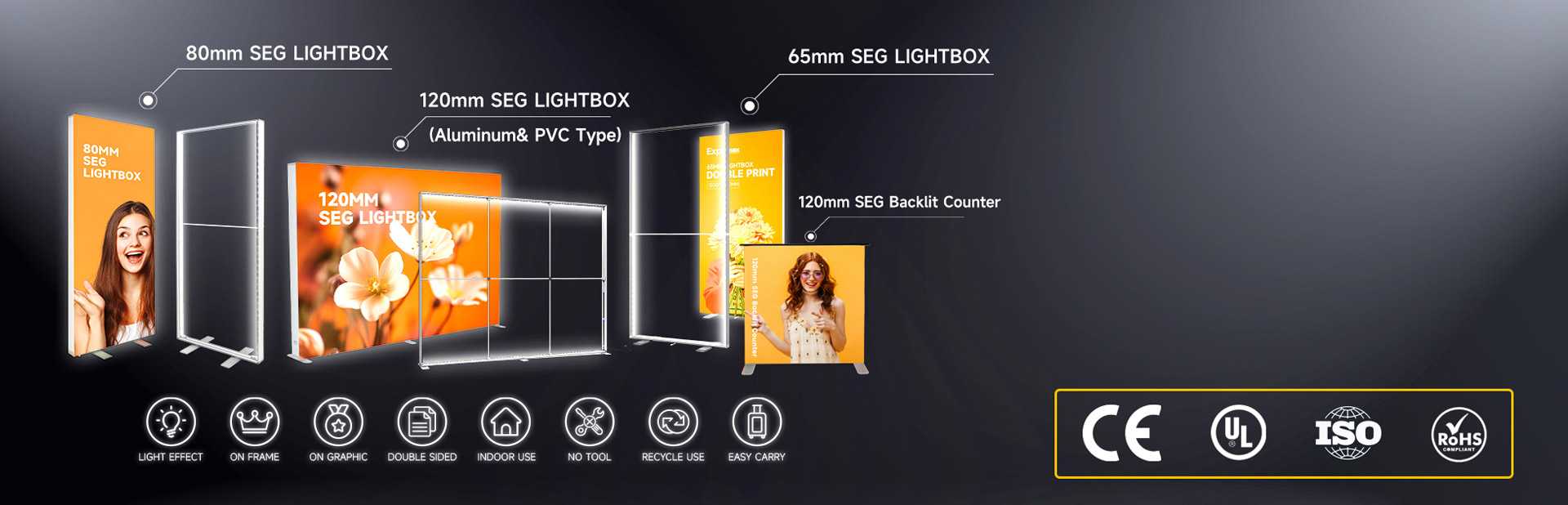
The 120mm SEG lightbox sits at the top of EXPOMAX's own depth ladder, above the 60/65mm walls the vendor assigns to retail promotions and showrooms and the 80mm depth it assigns to medium displays needing more stability. The review covers the four 120mm model codes: EM-18F, EM-18FA, EM-18FB and EM-18FBA, which differ in profile material and power supply rather than in depth.
This review is published by EXPOMAX (CHINA) ADVERTISING DISPLAY LIMITED, a manufacturer of tension fabric and portable exhibition displays operating from a 6,000-square-metre production facility in China. The company develops modular lightbox systems and holds multiple national patents and international certifications, and its SEGQUICK lightbox range is the product line this article examines. The guidance below is based on that manufacturing and product-development work rather than on third-party testing.
The Verdict: Who the 120mm Profile Is Right For
Verdict: 8/10 for large-format and modular booth builds
One-line summary: The EXPOMAX 120mm SEG lightbox is built for exhibitors who need a freestanding, double-sided or modular backwall and will trade transport weight and upfront cost for rigidity and even illumination.
Best for: Exhibitors and dealers building 10x10ft, 10x20ft and 20x20ft backwalls, towers and island booths.
Not ideal for: Buyers optimizing purely for minimum transport weight or the lowest upfront cost.
Pricing: Quote-based; no list price is published.
The 120mm depth is not a marketing preference. It is the depth the general depth-to-application rule assigns to large-format lightboxes, freestanding towers, double-sided displays and outdoor use, where extra profile depth improves wind resistance, rigidity and light uniformity. If your build is a modular SEG lightbox for trade show booths at that scale, the 120mm SEG lightbox is the right starting point. If it is a wall-mounted brand wall, it is more frame than you need.
Who Should Buy the EXPOMAX 120mm SEG Lightbox, and Who Should Not
That depth rule sorts buyers cleanly: the 120mm profile is right for exhibitors and dealers building large-format or double-sided structures, and wrong for anyone whose first constraint is freight weight or entry price. EXPOMAX's own depth ladder puts 60/65mm on retail promotions and brand walls, 80mm on medium displays, and 120mm on large freestanding lightboxes and modular booth systems, so the depth itself signals the build category rather than a quality tier.
Depth | Intended application |
|---|---|
60/65mm | Retail promotions, brand walls, showrooms |
80mm | Medium displays needing more stability |
120mm | Large freestanding lightboxes, modular booth systems, large-format exhibition displays |
Double-sided builds are the clearest reason to step up. According to one 120mm supplier's own comparison, the 120mm profile houses LED strips in both front and rear channels, which suits island booths approached from several directions. Treat that as a single-source vendor figure rather than an independently tested result.
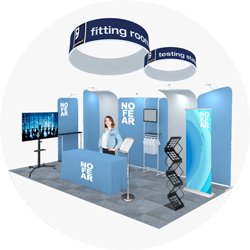
Booth size decides whether the depth is overkill. Pure Exhibits' guide to trade show booth sizes describes 10×10 as the standard entry point and 20×20 as the most popular island size, and the standard booth footprints line up with that split: 10×10 and 10×20 inline builds rarely need this depth, while 20×20 islands are where a modular SEG lightbox for trade show booths earns its cost.
How We Assessed It: Specifications, Not Lab Testing
Because the depth ladder above is a vendor classification rather than a test result, this review is based on EXPOMAX's published specifications and documented booth applications; we did not run independent durability or photometric testing, and no auditable cost or cycle-time figures were available for this model. Treat what follows as a specification-level assessment of the EXPOMAX 120mm SEG lightbox, not a measured performance test.
EXPOMAX manufactures the product under review. The sourcing for this assessment comes from EXPOMAX-controlled properties, including expomaxmedia.com, greenexpomax.com and the company's Alibaba storefront. Those pages can document what EXPOMAX builds and claims, but they cannot serve as third-party corroboration of quality or durability.
️ Warning: No independent test data was found for this model. Lumen output, wattage, colour temperature, MOQ, lead time and warranty terms are not published on any EXPOMAX page reviewed, so this review does not state them.
Modularity and Assembly: How the ABCD System Actually Builds a Booth
Yes, the frame is genuinely modular: the A, B, C, D and G frame modules combine into L-, U- and T-shaped layouts, and the same parts scale from a 10x10ft inline booth to a 10x20ft and 20x20ft island. Pure Exhibits describes 10x10 as the standard entry point for inline exhibits and 20x20 as the most popular island footprint (Pure Exhibits, 2026-01-01), which is exactly the range this profile is built to cover.
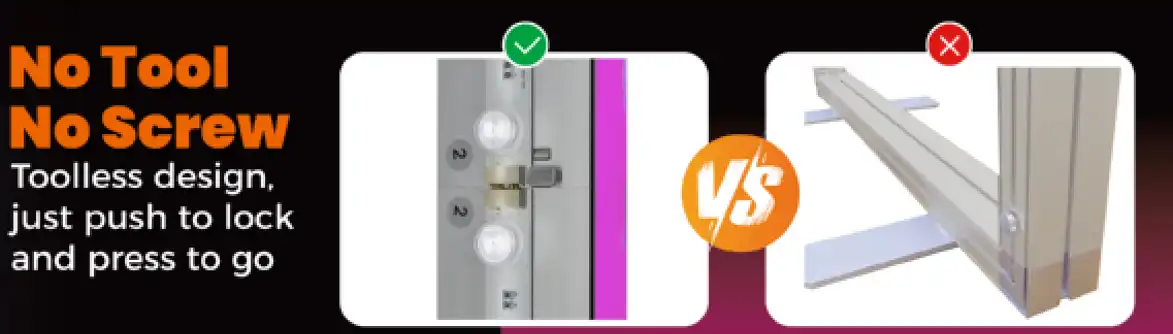
Assembly is tool-free. Modules lock through a quick-connect joint with an integrated ergonomic button system, and EXPOMAX claims a single inventory unit expands in 1-metre sections, so you buy depth once and add length as the stand grows.
For planning purposes, published setup windows are modest. All4Displays reports 15 to 35 minutes for one person on a 10x10 backlit display and 20 to 30 minutes for a SEG lightbox backwall (All4Displays, 2026-05-24). A 2026 exhibition lightbox booth guide puts the wider category at 15 to 45 minutes, tool-free or with minimal tools, one to two people (Frame-Plus, 2026-02-06). Treat one 120mm supplier's own comparison, which lists 15 to 30 minutes for its 120mm frame (Lintel Display, 2026-06-04), as a vendor figure rather than an independent benchmark.
The part that decides whether reuse actually pays off is the graphic, not the frame. A silicone strip sewn around the printed fabric presses into a narrow channel, corners first, and once all four sides are seated the face sits under tension and reads wrinkle-free, with the edge concealed. That is why a US supplier frames the reuse argument the way it does: modular lightboxes suit national rollouts and reconfigurable environments because graphics are swapped without replacing the frame, and aluminum frames are reused by simply switching fabric prints (SEG Systems, 2025-12-10).
Illumination and Build Quality: What the 120mm Depth Buys You
Depth is what makes the backlighting more even, and the reason is geometry. Back-lit uniformity follows a pitch-to-depth ratio with an industry norm of 1:1.5; when LED pitch is too wide for the frame depth, hotspots and zebra stripes appear. The same source puts the published optimal depth ranges at 4 to 25 cm for back-lit boxes against 2 to 8 cm for edge-lit, so a 120mm SEG lightbox sits inside the band where evenness is achievable.)
Depth also decides how large a wall you can light well. Edge-lit guides lose light toward the centre of the plate, and above roughly 2 m width the energy needed to reach the centre can exceed a back-lit grid, which is why edge-lit boxes struggle past two metres (ADLED, 2026-03-26). Long LED runs add a second failure mode: voltage drop dims the far end of a strip and shifts its colour temperature, the voltage-drop mechanism behind mismatched panels that do not match end to end.
On the frame, one 120mm supplier's own comparison specifies 6063-T5 alloy for the 120mm profile, chosen for rigidity-to-weight balance (Lintel Display, 2026-06-04). That grade matters more than the word "aluminum": Arrowhead Sign Company advises buyers to ask for extrusion wall thickness in millimetres rather than accept "aluminum" as a specification, because wall thickness and channel design determine how much flex a frame tolerates before joints loosen (2026-09-21).
What EXPOMAX does not publish for this model is lumen output, wattage per metre and colour temperature. Treat brightness as a configuration question to raise with the vendor rather than a number you can compare on paper.
PVC or Aluminum, and Which Model Code to Order
Choose PVC if the frame ships by air, gets replaced every couple of seasons, or needs the lowest landed cost. Choose aluminum if the same frame will be packed, freighted and rebuilt for years.
EXPOMAX's own PVC-versus-aluminum figures put PVC frames 30-40% lighter at equal size, with a 2 m × 1 m frame at 8-10 kg in PVC against 12-15 kg in aluminum, and 20-30% cheaper upfront (EXPOMAX, "PVC vs Aluminum SEG Lightbox", 2026-08-28). The same source gives PVC a 2-3 year service life against 5-10+ years for aluminum. Treat those as vendor figures: EXPOMAX sells both materials.
Model | Material | LED / PSU | Cost position | Best fit |
|---|---|---|---|---|
EM-18F (Classic) | Aluminum | Premium LED, MW power supply | Highest | Fixed installations |
EM-18FA (R1 SEGQuick Pro) | Aluminum | Standard PSU | Mid | The R1 build at a lower spec |
EM-18FB (R2 SEGQuick ULTRA) | PVC | Standard | Lowest material cost, reduced tariff exposure | Air-freighted, short-cycle programs |
EM-18FBA (R2 SEGQuick ULTRA) | Aluminum | Standard | Higher than PVC R2 | Repeated freight, sustainability reporting |
Model codes come from EXPOMAX's 120mm SEGQUICK family, the SEGQUICK modular lightbox line that also covers 65mm and 80mm depths. The PVC R2 is the one with published weights: the published EM-18FB spec table lists gross weights from 40 lbs at 39.37×78.74 in up to 120 lbs at 236.22×98.43 in, in cases from 14×7×45 in to 14×13×45 in, with two cases on the largest sizes.
Two claims on that page are marketing, not measurements: the vendor's own speed claim of "10 minutes, six times faster than traditional systems," and the vendor's own container-loading claim of "138 additional sets per 40HQ." Neither ships with a stated method or baseline.
Evidence, Limitations and the Final Recommendation
The EXPOMAX 120mm SEG lightbox fits large-format, freestanding or double-sided builds that will be reused across shows. It is the wrong starting point if minimum freight weight or lowest entry cost drives the decision.The strengths are structural. One 120mm supplier's own comparison puts the profile at roughly 12 to 14 kg for a 2×2 m frame against 6 to 7 kg at 60mm and 8 to 10 kg at 85mm, and gives it spans up to 6 m wide by 4 m high versus 2 m and 3 m for the narrower depths. That mass buys the modularity and the double-sided capability, and the material choice lets you trade weight against service life.
The weaknesses are equally concrete: it is the heaviest and most expensive depth in the range, and no lumen output, wattage, warranty terms or certification documents were found on any EXPOMAX page reviewed.
EXPOMAX is a specialized manufacturer of tension fabric and portable exhibition displays, operating a 6,000 m² production facility, holding multiple national patents and international certifications, and serving a global clientele across North America, Europe and beyond. The category is expanding: the LED fabric lightbox market forecast projects growth from $375.0 Mn in 2026 to $730.0 Mn by 2036 at a 6.9% CAGR, with premium booth walls at 32.0% of use cases (Fact.MR media release, 2026-07-30).
Key Takeaway: Choose the 120mm profile when span, modularity and reuse across shows drive the decision. Choose 65mm or 80mm when freight weight or entry cost does.
Next step: compare configurations against your booth footprint, or talk to an expert about which depth fits your build.
Frequently Asked Questions
Is the EXPOMAX 120mm SEG lightbox worth the price?
Yes, if you will reuse the frame across multiple shows. EXPOMAX does not publish a list price, so the honest benchmark is the reseller market: reseller pricing for 10×10 backlit displays runs $600–$3,000, and SEG lightbox backwalls $800–$2,500 (All4Displays, retrieved 2026-05-24). The same source puts replacement graphics at 40–60% below the cost of a full package, which is where a 120mm frame earns its money back: you buy the structure once and re-skin it per event.
How does the 120mm profile compare to 60mm and 85mm SEG frames?
120mm is the depth for large freestanding lightboxes and modular booth systems, while 60–65mm suits retail promotions and showrooms and 80mm covers medium displays needing extra stability (the general depth-to-application rule, HBMGZ, 2026-06-07). The reason is optical: greater depth lets LED pitch spread further from the graphic, which is the LED engineering behind why depth controls evenness (ADLED, 2026-03-26). On weight, one 120mm supplier's own comparison is a vendor figure, not an independent measurement.
Does the EXPOMAX 120mm SEG lightbox offer a free plan or trial?
No. A free plan or trial does not apply to a physical display product. The equivalent path is a sample, a quote, and OEM/ODM customization through EXPOMAX's dealer channel, and the model range is EXPOMAX's 120mm SEGQUICK family. Neither minimum order quantity nor production lead time is published, so confirm both with the supplier before committing.
What are the biggest drawbacks of the EXPOMAX 120mm SEG lightbox?
Three stand out. Weight and freight cost rise with the deeper profile, it sits at the highest price tier of the SEG range, and EXPOMAX publishes no lumen output, wattage, warranty terms or certification documents. Budget for shipping and request the missing specifications in writing.
Who is the EXPOMAX 120mm SEG lightbox best for?
It suits exhibitors and dealers building large-format, freestanding, double-sided or modular booth structures who will reuse the frame across events. It does not suit buyers who need the lightest, cheapest single-use display, or who require published photometric and certification data before purchase. If you are weighing frame material, the PVC vs aluminum SEG lightbox choice comes down to cost versus structural stability.
Conclusion
The EXPOMAX 120mm SEG lightbox fits large-format, freestanding and double-sided builds where a modular booth has to be reconfigured between shows. It is not the lightest or the cheapest way to put a graphic on a wall.
Modularity: the 120mm profile expands in 1-meter sections from a single inventory unit, so a 10x10ft booth and a 20x20ft backwall can come out of the same stock.
Assembly: the SEGQuick system is sold as tool-free, with an integrated button system rather than loose hardware.
Depth: 120mm is the depth EXPOMAX itself assigns to large freestanding lightboxes and modular booth systems, not to retail promos.
Material: the PVC R2 profile exists to cut material cost and tariff exposure; the aluminum R2 targets structural stability, lighter weight and cleaner packaging.
Specs to confirm before ordering: lumen output, wattage, warranty terms and certification documents are not published on the pages reviewed, so ask for them with your quote.
If your booth programme turns on reconfiguration and graphic quality rather than freight weight, this profile is worth pricing. Compare the 120mm configuration against your current build before you commit.







View More(Total0)Comment lists