


 marketing@expomax.com.cn

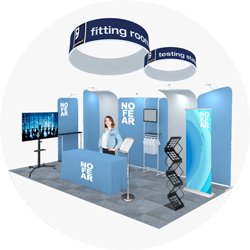
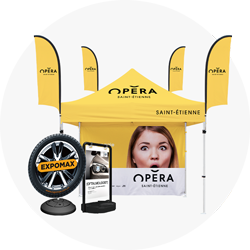
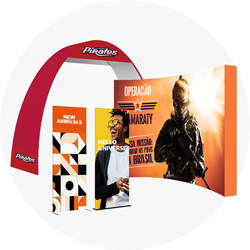

SEG Lightbox Frame Depth: 60mm vs 80mm vs 120mm
You've narrowed to three depth classes, so the question is no longer what a SEG lightbox is but which frame depth your build actually needs. Frame depth is the single specification that drives the rest of the decision, because it sets how much room the LED modules have to spread light before it reaches the fabric, and how much aluminium stands between the graphic and the floor.
The trade is consistent across every build: more depth buys even illumination and a stiffer frame, and costs weight, packed volume and money. This comparison works through five dimensions, illumination evenness, structural rigidity and span, mounting and booth configuration, portability and packing, and total spend, then closes with the specification questions to put to any supplier.
One limit up front. The comparison rests on published frame specifications and manufacturer documentation for the 60 mm, 80 mm and 120 mm classes, not on our own side-by-side testing. Actual performance varies with the LED module, the fabric weight and the build configuration, so treat the depth classes as a starting filter and confirm the numbers against the specific product datasheet before you commit.
This guide is published by EXPOMAX (CHINA) ADVERTISING DISPLAY LIMITED, a manufacturer of tension fabric and portable exhibition displays operating from a 6,000-square-metre production facility in China. Its work covers modular lightbox systems and SEG printing, which is the subject of this comparison of 60mm, 80mm and 120mm frame depths.
SEG lightbox frame depth compared: the specification matrix
The three depths are not a quality ladder. They are three answers to different installation problems, and the specification matrix below puts the verdict in front of you before the detail.
Criterion | |||
|---|---|---|---|
Best for | Retail interiors, permanent wall displays | Medium freestanding displays | Modular booth and large-format builds |
Typical application band | Standard wall-mounted retail panels, 60–100 mm | Counter and POS features, 40–80 mm; wall panels to 100 mm | Large-format window backgrounds, 100–150 mm |
Freestanding stability | Weaker freestanding; lighter and easier to transport | Balanced; enhanced rigidity for medium freestanding use | Strongest; 100–120 mm adds freestanding stability |
Illumination evenness | Even on slim wall panels | Even at moderate spans | Most uniform; more room for LED spacing |
Portability and packing volume | Lightest | Middle | Heaviest |
Span behaviour | Short spans only | Moderate spans | Longest spans; deeper sections resist deflection |
Single- vs double-sided | Single-sided wall work | Either | Double-sided and modular |
Frame section and alloy | Slim extrusion, roughly 1.0–1.5 mm wall | Mid-range, 1.2–2.0 mm | Deep profile, roughly 1.8–2.0 mm |
Who it suits | Retail fit-out and interior contractors | Sign shops needing freestanding flexibility | Exhibition builders and OEM partners |
Overall | Choose 60 mm for permanent wall work, 80 mm when the unit must stand free at moderate size, 120 mm for booths, long spans and double-sided builds |
This matrix is a planning reference. The specific product datasheet governs the final specification.
How frame depth changes illumination evenness
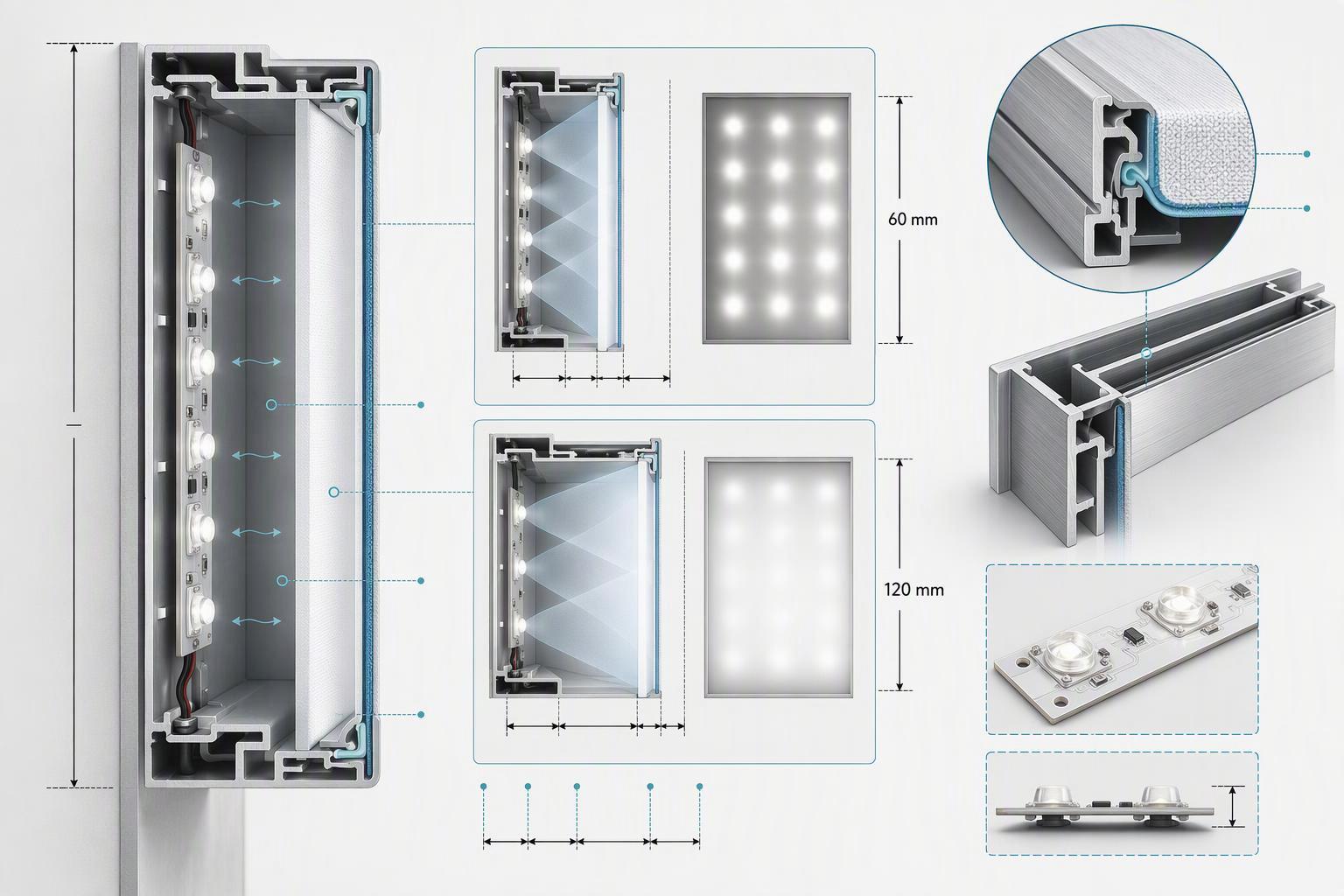
Frame depth matters because it sets the mixing distance between the LED array and the printed graphic, and that distance is what turns individual light sources into an even field. A fabricator's planning reference puts the practical floor at 60 mm or more "to give the light enough space," and notes that shallower-than-spec builds show "visible bright spots, sometimes called hot spots or LED dots" (VM Display Solution, retrieved 2026-08-25).
Depth alone does not decide the result. LED vendors' pitch-to-depth rule of thumb starts at distance equal to pitch, rises to 1.5x pitch as the widely cited planning standard, and reaches up to 2.5x pitch with wide-angle optics; shallow boxes in the 30-60 mm band generally need edge-lit modules with tighter LED spacing . The diffuser adds its own requirement: it needs standoff from the array, typically a minimum of 1/2 inch and sometimes 1 inch or more, which is the edge-lit versus direct-lit depth trade-off.
Evenness is therefore a four-variable balance of depth, pitch, diffusion and cavity reflectivity. A shallow frame paired with wide pitch carries the highest hotspot risk, while white, highly reflective internal surfaces and layouts that block line of sight to individual LEDs improve homogeneity. A 60 mm frame with tight pitch and good diffusion can outperform a poorly specified deeper unit.
How frame depth changes structural rigidity and span
Depth buys rigidity more efficiently than wall thickness does. A deeper profile places more material farther from the neutral axis, which raises resistance to bending and reduces visible sag across a span, so bending stiffness is driven mainly by section geometry rather than by a modest increase in wall gauge. Deflection scales with the cube of the span, so doubling an unsupported run costs eight times the deflection at the same section.
Wall thickness still matters for how much flex a frame tolerates before joints loosen, and it is the number to ask for in millimetres rather than accepting "aluminum" as a specification. Typical commercial extrusions run roughly 1.2 to 2.0 mm, with slim profiles nearer 1.0 to 1.5 mm and deep profiles nearer 1.8 to 2.0 mm; below about 0.8 mm there is little margin. This is where SEG lightbox frame thickness and frame depth stop being interchangeable numbers.
Alloy choice follows the same logic. 6063-T5 is the anodising default because it takes a clean visible finish, while 6061-T6 offers higher yield strength and fatigue resistance for large-format and freestanding builds at the cost of finish quality.
A deeper frame is not automatically more stable. Twisting depends on section geometry, wall uniformity and corner joints, and there is no universal span limit.
Key Takeaway: Longer unsupported spans need more depth, thicker walls, a stronger alloy or intermediate support. Depth alone does not fix a weak corner joint.
Which depth for wall-mounted, freestanding and modular booth builds
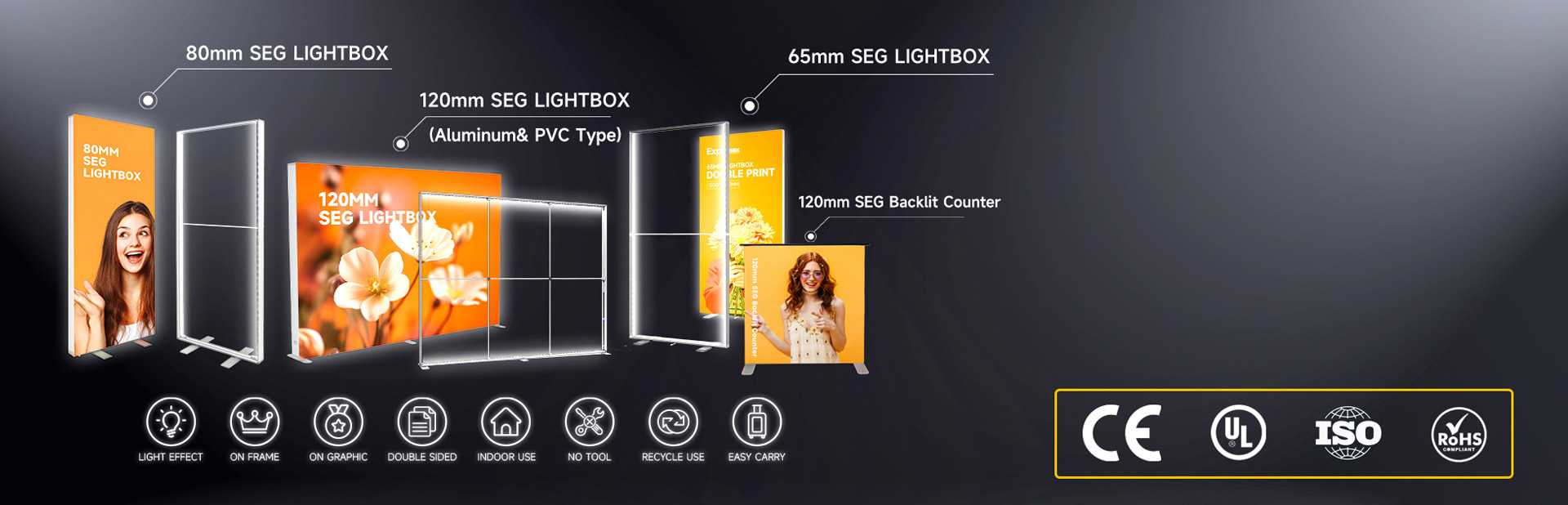
The mounting condition decides the depth class before size or budget enters the conversation. Wall-mounted and back-closed units sit at 60 mm, freestanding builds at 80 mm, and modular booth systems at 120 mm.
For wall-mounted retail interiors and permanent wall displays, EXPOMAX positions its 60mm Wall Mounted SEG Lightbox as the standard band, and a display supplier's depth guide puts standard wall-mounted retail panels at 60–100 mm. A single-sided SEG lightbox can be slimmer still, because there is no rear face to light: single-sided versus double-sided construction allows a slim profile when the unit is wall-mounted or back-closed.
Freestanding is the balance point. The 80mm modular profile covers medium-sized free-standing displays, while 100–120 mm adds the stability a lighter 60–80 mm frame lacks in a high-traffic aisle.
A modular SEG lightbox for trade show booth work moves to 120 mm, the 120mm flagship series, because one profile must carry span, accept centre supports and internal bars, and survive repeated pack-ship-reassemble cycles across the supported booth footprints of 10×10 ft, 20×10 ft and 20×20 ft. Double-sided SEG lightbox builds generally need deeper profiles, heavier sections and substantial feet, with large illuminated double-sided systems running well past 120 mm.
The smaller depth wins in one sub-scenario: a 120 mm frame behind a 1 m wall panel is wasted packing volume and cost.
What each depth costs in portability, packing and total spend
Depth is not a reliable price proxy. A shallow frame built from a high-specification alloy can cost more than a deep economy frame, so compare the construction variant, not the millimetre figure alone.
Weight and packing follow the depth class. A display supplier's depth guide notes that 60 to 80 mm frames are lighter and easier to transport, while 100 to 120 mm profiles add freestanding stability at the cost of weight and crate volume. That weight shows up again in freight and storage across a show season.
Material grade drives cost within a class. Extrusion engineering guidance puts deep profiles at 1.8 to 2.0 mm wall thickness against 1.0 to 1.5 mm for slim builds, so a 120 mm frame carries more alloy per metre. The 120mm SEG lightbox range shows the same split across its four configurations: the 120mm series configurations run from the EM-18F Classic to the R2 SEGQuick ULTRA PVC, and the R1 and R2 construction split sets premium aluminium against an economical PVC option on the same modular design.
Cost driver | 60 mm | 80 mm | 120 mm |
|---|---|---|---|
Frame material and variant | Slim alloy, wall-mount class | Alloy, modular | R1 aluminium or R2 PVC/aluminium |
LED module density implied by pitch | Lowest | Moderate | Highest |
Packing volume and crate size | Smallest | Mid | Largest |
Assembly labour | Least | Moderate | Most, plus heavier feet or ballast |
Lower total cost when | Permanent wall displays | Medium freestanding builds | Trade show and exhibition booths |
Pro Tip: Ask for the alloy grade and wall thickness before the depth. Those two numbers move the quote more than the profile size does.
The record stops short of a total-cost figure: no vendor publishes assembly time, dimensional weight or crate dimensions by depth, so budget those from your own freight quotes rather than a specification sheet.
How to specify a frame depth in practice
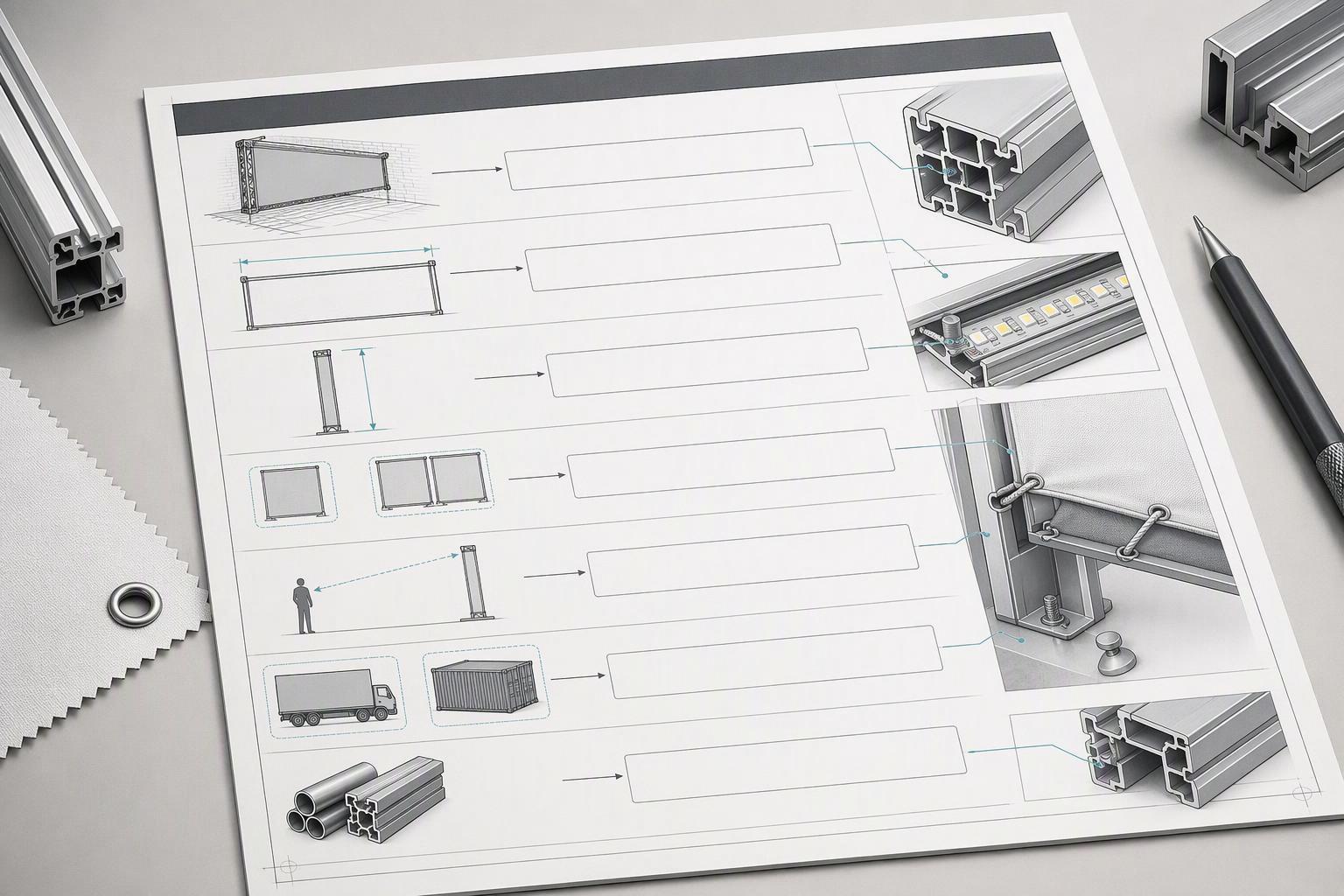
Work backwards from the mounting condition, not forwards from the depth number. Frame depth is the last variable you settle, after five inputs: mounting surface and whether the unit is back-closed or double-sided; span width and height and whether intermediate support is possible; viewing distance, which sets how much diffusion distance the evenness actually needs; transport mode and how many times a year the unit is packed and rebuilt; and graphic change frequency, which sets how much the frame must tolerate repeated gasket reseating.
Key Takeaway: Settle five inputs before choosing a depth: mounting condition, span, viewing distance, transport mode, and graphic change frequency.
Then vet the supplier on measurements rather than materials. Wall frames can run about 20 mm while backlit units often need 100 mm or more of structure, and most quality SEG frames are extruded from anodized 6063-series aluminium, so ask for the supplier vetting questions that expose dimensional tolerances held on profile width, channel geometry and corner assemblies. Ask for the extrusion's wall thickness in millimetres rather than "aluminum", because vague specs usually mean thinner, cheaper stock, as Arrowhead's buying guide notes. Confirm the alloy grade, then the LED pitch and diffuser standoff rather than the depth alone.
On receipt, check for what actually breaks in the field: loose fasteners from shipping vibration are the most common frame issue, while cracked extrusion, bent members or failed connectors that prevent square assembly are the structural failures worth rejecting. EXPOMAX's SEGQUICK range, for instance, splits into five series across 60 mm, 65/80/120 mm and booth systems, so the depth class is a menu rather than a single answer.
Who should choose which depth
If the display is wall-mounted or back-closed and staying put, choose 60 mm. If it is freestanding at medium size and has to travel, choose 80 mm. If it is a modular booth build, large-format, double-sided or repeatedly shipped, choose 120 mm.
Retail interior fit-out. Wall-mounted, permanent, viewed from one side: the 60 mm class exists for exactly this, and the extra depth buys nothing you can see.
Travelling exhibitor with a 10×10 or 20×10 booth. The 120 mm modular class is built around those footprints, and the modular SEG lightbox design is what makes repeated pack-down and rebuild practical rather than a one-off installation.
Agency or dealer specifying across clients. Depth follows the client's mounting condition, not a house standard. A SEG lightbox for trade show booth work and a retail wall display rarely want the same frame.
Large-format double-sided builds. Here none of the three classes is automatically sufficient. Single-sided versus double-sided construction changes the load case, and a heavier engineered system is the honest answer.
EXPOMAX manufactures SEG lightboxes in these depth classes, including the SEGQUICK modular range offered in 60 mm, 80 mm and 120 mm. The specification sequence above is the one used to configure them.
FAQ
Is a deeper SEG lightbox always brighter?
No. Brightness and evenness come from the combination of frame depth, LED pitch, diffusion distance and how reflective the cavity walls are. A display supplier's depth guide treats depth as one variable in that set, not a ranking of output. A 120 mm frame with a coarse pitch can look blotchier than a well-specified 80 mm build.
Can a 60 mm SEG lightbox frame be used freestanding?
Only at small sizes and in low-traffic positions. Stability depends on the base feet and ballast you add, not on depth alone, so a shallow frame on a wide footprint can still be safe. Where footfall is heavy or the panel is tall, move up a depth class.
What actually changes between an 80 mm and a 120 mm frame in a modular SEG lightbox?
Span, centre support and packing volume change more than brightness does. The 120 mm class carries longer unsupported runs and needs fewer intermediate supports, but it ships and stores bulkier. LED vendors' pitch-to-depth rule of thumb is the useful starting point: match pitch to viewing distance first, then pick the depth that holds the span.
Can I mix depth classes in one booth build?
Yes. Frames of different depths bolt together without a structural problem, and the real constraint is visual consistency at the seams, where a step in depth reads as a shadow line under raking light. Keep the visible faces flush and the mix disappears.
How do I check a frame's real specification before ordering?
Ask for wall thickness in millimetres, alloy grade, and the tolerances the extrusion is held to. Arrowhead's buying guide and extrusion engineering guidance both put those three ahead of any marketing description of the profile. Then confirm LED pitch and diffuser standoff in writing.
Conclusion
The decision rule comes down to three inputs. Choose a 60mm SEG lightbox when the frame sits against a wall in a retail or permanent interior and depth is dead weight. Choose an 80mm SEG lightbox when the display stands free at a medium size and needs to hold its own shape. Choose a 120mm SEG lightbox when the build is a trade show booth, a large-format span, or a modular system you intend to reconfigure across shows. Frame depth is not a quality ranking, it is a fit decision, and the right SEG lightbox frame depth is the shallowest one that still meets your span, evenness and reuse requirements.
If you have settled those inputs, the next step is a specification conversation rather than a purchase. Request the SEGQUICK dealer pack, specification sheet or installation video and we will match the depth class, module configuration and power supply option to your booth footprint and market.








View More(Total0)Comment lists