



 marketing@expomax.com.cn


Aluminum vs PVC SEG Fabric Light Box: Which Is Better for Your Display Business?
Aluminum vs PVC SEG Fabric Light Box: Which Is Better for Your Display Business?
Every distributor sourcing SEG fabric light boxes eventually hits the same fork in the road: aluminum frame or PVC frame? The spec sheets look similar. The SKU photos look nearly identical. But the material choice ripples through every aspect of your business — landed cost, warranty callbacks, client satisfaction, and the long-term margin on every graphic refresh order you sell.
This guide breaks down the real differences across the seven factors that matter most for display businesses and resellers: structural performance, thermal behavior, weight, cost of ownership, sustainability, tariff exposure, and use-case fit. By the end, you will know exactly which frame to stock for which customer.
Aluminum vs PVC SEG Light Box: Quick Comparison
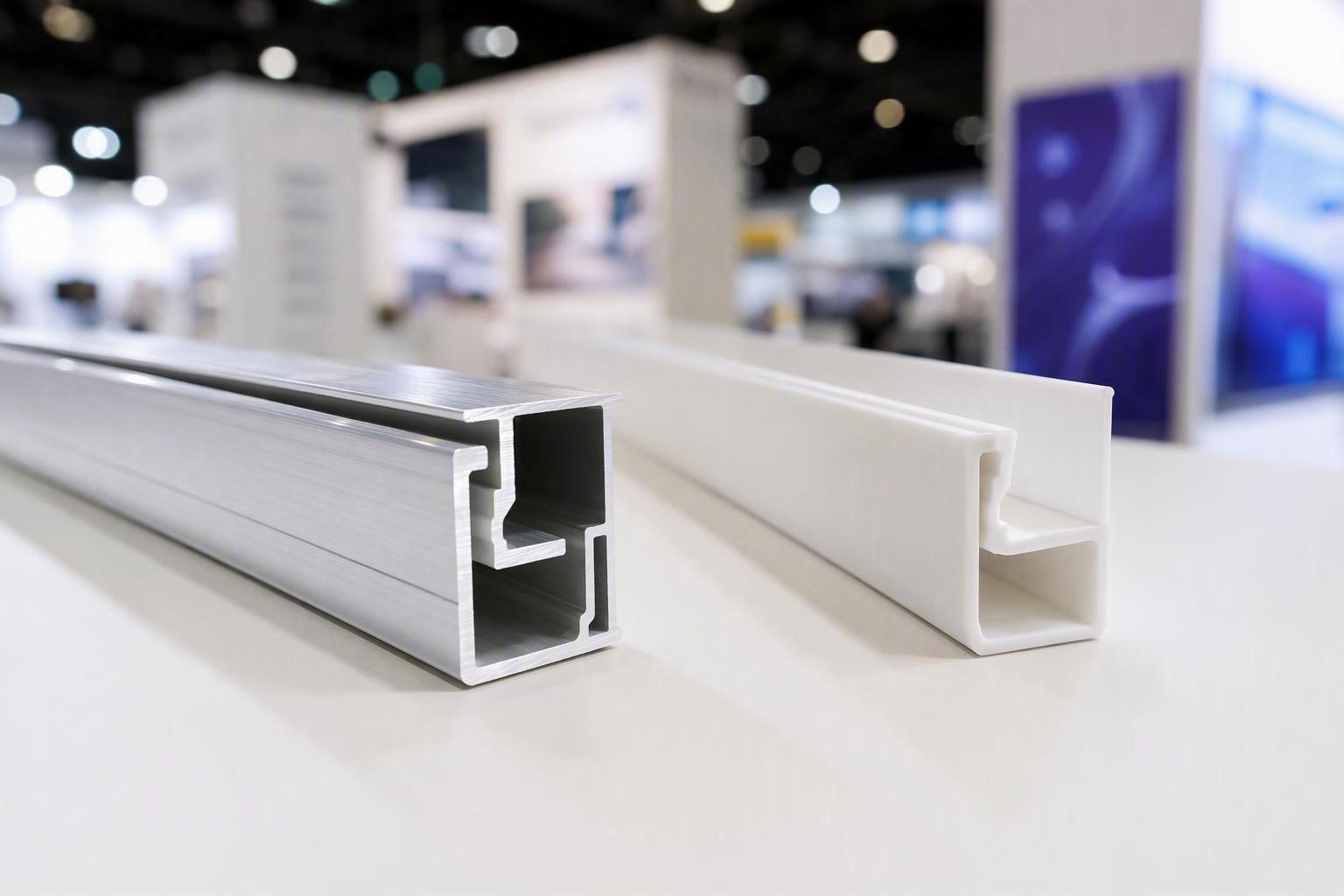
| Evaluation Factor | Aluminum Frame | PVC Frame | Winner by Use Case |
|---|---|---|---|
| Tensile strength (6063-T5) | ≥140 MPa | Lower, material-dependent | Aluminum — large formats |
| Deflection under fabric tension | Minimal | Noticeable above ~4 ft | Aluminum |
| Thermal conductivity | ~160–210 W/(m·K) | ~0.15–0.2 W/(m·K) | Aluminum — LED longevity |
| Weight (2 m × 1 m frame) | 12–15 kg | 8–10 kg | PVC — solo transport |
| SEG groove tolerance | ±0.1 mm typical | Wider variance | Aluminum |
| Service life in active use | 7–10+ years | 2–3 years | Aluminum |
| Upfront cost | 30–60% higher | Lower | PVC — entry tier |
| Modular booth scalability | High, consistent alignment | Limited at booth scale | Aluminum |
| Recyclability | Infinitely recyclable | Landfill-bound | Aluminum |
| Tariff classification impact | Higher in some HTS classes | Positioned as mitigation | PVC — tariff-sensitive markets |
Read the table as a starting point, not a verdict. The sections below explain when each advantage actually translates into business value — and when it does not.
What SEG Frame Material Actually Controls
The frame is the skeleton of the entire system. An SEG light box works because a silicone bead sewn around the perimeter of a dye-sublimation fabric graphic snaps into a precision-routed groove in the frame. Everything downstream — how tight the graphic looks, how cleanly the LED illuminates it, how many cycles the system survives — depends on that groove holding its geometry.
Frame material determines:
Groove dimensional stability across temperature cycles
Structural rigidity at large formats
Heat conductivity away from the LED array
Weight per linear foot of extrusion
How many assembly and disassembly cycles the connection hardware tolerates
Aluminum and PVC approach each of these differently.
Structural Rigidity: Where the Gap Is Most Visible
Aluminum extrusions used in professional SEG light boxes are typically manufactured from 6063-T5 alloy — the same material common in architectural window profiles and commercial signage. This alloy reaches a tensile strength of at least 140 MPa in standard thicknesses, which means it resists the inward bowing that large-format SEG fabric imposes on the frame as the graphic is pulled taut.
PVC frames are softer. Under the same tensile load from a taut graphic, a PVC profile deflects measurably more than an equivalent aluminum section. For displays under roughly 4 ft × 4 ft, this is often invisible to the eye. Once you move into large-format territory — the 10 ft backwalls, the 20 ft booth systems that exhibition distributors build their rental fleets around — PVC sag becomes a real quality issue. Clients notice it. And callbacks are expensive.
Key Takeaway: For any display format above 4 ft in either dimension, aluminum rigidity is not a premium feature — it is a structural requirement.
Thermal Performance and LED Longevity
This is the factor most buyers overlook, and it directly affects your warranty exposure.
LED strips generate heat. In a backlit SEG light box, that heat needs to dissipate through the frame. Aluminum is among the best thermal conductors available in structural materials — its thermal conductivity sits around 160–210 W/(m·K) depending on alloy. Heat moves from the LED contact point into the aluminum extrusion and dissipates across the frame surface. LED junction temperatures stay low. Rated lifespan is achieved in real deployments.
PVC has a thermal conductivity roughly 400 times lower. Heat from the LED strips has nowhere to go efficiently. Internal frame temperatures climb. At elevated sustained temperatures, two things happen: LED lumen output begins to degrade faster than rated, a phenomenon called thermal droop, and the PVC profile can begin to soften and permanently deform over months of sustained use — particularly in warm retail environments or summer outdoor events where ambient temperatures routinely exceed 35°C.
For a rental display company, this translates directly to replacement cycles and labor. An aluminum frame running cooler will hold its geometry for years. A PVC frame in a warm retail window may need replacing in under two years.
Weight: The One Area PVC Genuinely Wins
Factually, PVC frames are lighter than aluminum at equivalent cross-section dimensions — typically 30–40% lighter for the same size display, as documented by Expomax's own product comparison data. A standard 2 m × 1 m PVC frame weighs approximately 8–10 kg; the aluminum equivalent runs 12–15 kg.
For a solo exhibitor carrying a display through an airport, this matters. For a display distributor managing a rental fleet of twenty 10 ft × 8 ft backwalls, the weight difference per unit is real freight savings on each shipment.
The honest answer is that the weight advantage is situational. If your core business is large-format rental displays that ship to the same venue ten times a year, heavier aluminum frames add shipping cost over the fleet's lifetime. If you are selling single-event compact displays to small teams, PVC's lighter weight is a genuine benefit to pass on to the end customer.
Pro Tip: For rental-fleet economics, calculate the cumulative freight difference over 3 years of weekly shipments. In many cases, the TCO of the heavier aluminum frame is still lower because it simply lasts longer and requires fewer replacements.
SEG Groove Precision: The Silent Quality Killer
The silicone edge bead that creates the SEG tensioned graphic is approximately 5 mm or 7 mm in diameter depending on profile specification. It needs a groove that grips it firmly, holds it in tension, and does not allow it to creep or pop out under handling.
Aluminum extrusions are manufactured to tight dimensional tolerances — a competently produced aluminum SEG groove profile maintains its channel width to within ±0.1 mm along its full length. The bead seats fully. The graphic face is even. Installation is predictable.
PVC profiles have wider manufacturing tolerances and are susceptible to two additional deformation mechanisms: thermal expansion and contraction in response to ambient temperature changes, and elastic relaxation under repeated bead insertion force. In cold installation environments, PVC stiffens and the groove contracts slightly, making installation harder. In warm environments, the groove softens slightly, which can allow the bead to seat inconsistently.
Neither effect is catastrophic in a single installation. Across hundreds of client deployments, they generate a steady stream of "the graphic doesn't look right" callbacks that your installers spend time on.
Total Cost of Ownership Across Graphic Refresh Cycles
This is the number that changes most purchasing decisions when distributors model it honestly.
SEG displays are fundamentally a consumable-hardware model: the frame is reused, and graphics are replaced. The economics of this model only work if the frame survives enough refresh cycles to justify its price premium over competing display types.
A well-produced aluminum frame, properly cased for shipping, will survive hundreds of assembly cycles. Industry guidance commonly cites 7–10+ years of service life for aluminum frames in professional display applications. At a conservative estimate of four graphic refreshes per year, that is 30 or more replacement graphic orders generated by a single frame — recurring revenue for the distributor or reseller who sold it.
PVC frames in comparable service conditions typically show wear at connection hardware and groove edges within 2–3 years of active use. You replace the frame sooner. The end customer either absorbs the cost or attributes it to the quality of your supply.
The math is straightforward: the higher upfront cost of aluminum, typically 30–60% above an equivalent PVC frame, can be recovered through longer service life and fewer frame replacements.
Modular Compatibility and Booth-Scale Scalability
One area where aluminum's engineering precision becomes a competitive commercial advantage is modular scalability.
Professional modular SEG light box systems — the kind that exhibition distributors use to build 10 ft × 10 ft, 20 ft × 10 ft, and 20 ft × 20 ft illuminated booth configurations — rely on precision corner extrusions, connection keys, and panel alignment hardware. These components maintain dimensional accuracy across tens of panels joined together. A 20 ft backwall assembled from aluminum modules aligns seamlessly because every extrusion is manufactured to the same tolerance class.
PVC modular systems exist, but the material's dimensional variability under temperature and load makes large-format panel alignment noticeably less consistent. At small display sizes this does not matter. At exhibition booth scale, it shows.
Expomax's SEGQUICK modular lightbox system offers modular display solutions designed for exhibition, retail and commercial applications. The product range includes different profile depths and frame configurations, allowing distributors to match the display system to different applications and project requirements.
Sustainability and Compliance Positioning
This factor is growing in commercial weight. US and European buyers in the corporate, government, and enterprise retail sectors increasingly ask their display suppliers for end-of-life documentation and recyclability commitments.
Aluminum is infinitely recyclable without material property loss. Recycled aluminum requires significantly less energy than producing primary aluminum. A distributor sourcing aluminum-frame displays can therefore position a product line around long-term reuse and recyclability when supported by appropriate product lifecycle practices.
PVC recycling infrastructure is more limited and fragmented. For distributors selling to customers with ESG reporting requirements, material selection can therefore become an increasingly important procurement consideration.
Import Tariff Considerations for US-Based Distributors
One market-specific factor worth naming directly: US Section 301 tariffs on Chinese-manufactured goods can affect aluminum and PVC display products differently depending on HTS classification. PVC-frame light boxes may be considered by some suppliers as a tariff-mitigation option where material classification affects the applicable rate.
This consideration is real and should be verified with a qualified customs broker for specific SKUs. However, it should be weighed against total cost of ownership. A lower-tariff PVC frame that needs replacing more frequently does not necessarily generate better landed economics than a longer-lasting aluminum frame.
Which Frame Belongs in Your Product Line?
The answer is not binary. Most display distributors and resellers can benefit from carrying both materials and positioning each product toward the right customer segment.
Stock Aluminum Frames for:
Trade show rental fleets and multi-event deployment inventory
Large-format installations
Retail chain rollouts where graphic refresh is the recurring revenue model
Clients with premium positioning or ESG requirements
Corporate event and exhibition companies where setup reliability is important
Modular exhibition booth solutions
Long-term reusable display applications
Stock PVC Frames for:
Entry-level or budget-tier product lines for price-sensitive customers
Single-event or short-run promotional display orders
Compact display sizes where structural rigidity is not a limiting factor
Lightweight display applications
Markets where landed cost is a major purchasing consideration
Key Takeaway: PVC expands your addressable market at the entry level. Aluminum protects your margin and your client relationships at the professional tier. Running both lets you serve the full distribution spectrum.
What to Evaluate When Sourcing Either Frame
Whether you are evaluating aluminum or PVC suppliers, the same technical questions apply:
For the Groove
What is the specified channel width and tolerance? Does it match standard 5 mm and 7 mm SEG bead sizes, or does it require proprietary fabric from the same supplier?
For the LED System
Is it edge-lit or direct backlit? What is the color temperature? What CRI rating? What is the rated operating life under continuous use conditions?
For the Connection Hardware
Is the corner and panel connection tool-free? If not, what tools are required, and will your installation teams have them on-site?
For the Extrusion Finish
Is the aluminum anodized or painted? For rental applications, surface durability and resistance to scratching and corrosion should be considered during supplier evaluation.
For Replacement Graphic Compatibility
What is the exact groove specification so you can verify that graphics printed and sewn by your local trade printer will fit?
Expomax's SEG Lightbox product family covers 65 mm, 80 mm, and 120 mm profile depths, providing distributors with multiple display configurations for different installation environments and project requirements.
The Bottom Line
For the majority of professional display business applications, aluminum is the correct default. Its structural performance at large formats, thermal management, service life, modular scalability, and sustainability credentials can outweigh the higher upfront cost when the total cost of ownership is considered.
PVC has a genuine role in entry-level and price-sensitive segments. For distributors managing different customer requirements, carrying both aluminum and PVC options can create a more flexible product portfolio.
The display businesses that build durable client relationships are the ones whose products work reliably on every setup, at every venue, across every graphic refresh cycle. Material selection is an important part of achieving that reliability.
Ready to evaluate aluminum and PVC SEG light box options for your distribution inventory? Explore Expomax's SEG Booth Solutions or explore the Modular SEG Lightbox range for exhibition, retail and commercial applications.
For OEM/ODM requirements, product specifications, customized display solutions and reseller opportunities, contact Expomax at marketing@expomax.com.cn.





View More(Total0)Comment lists