


 marketing@expomax.com.cn




How Are SEG Lightboxes Powered: Plug-In Power, Adapters and Battery Options
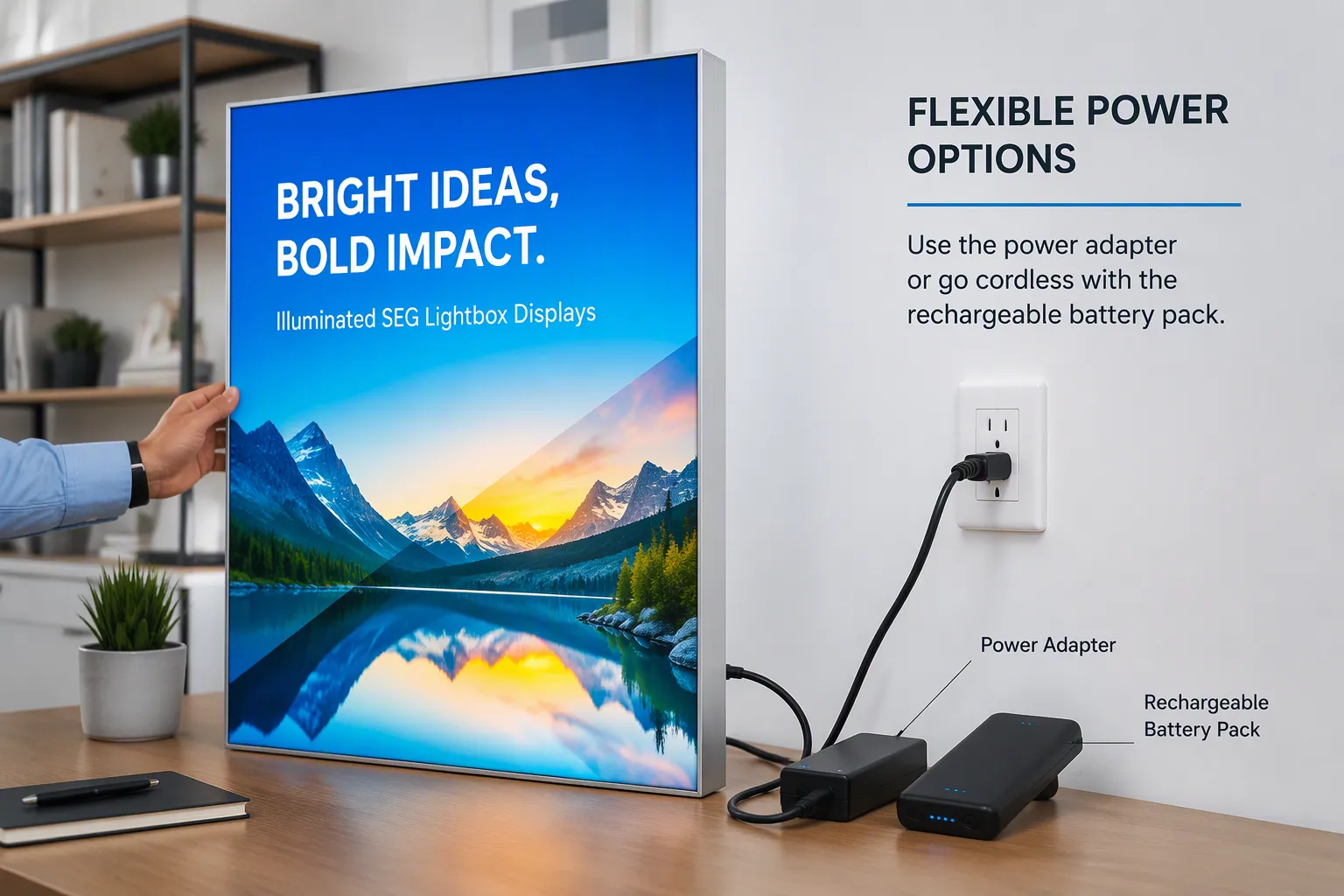
A SEG Lightbox uses low-voltage LED modules. You can power one in three practical ways: plug-in AC power, an AC-to-DC adapter (an internal or external power supply), or a rechargeable battery pack. Your choice depends on three things. How permanent is the setup? Where does the display sit? What is your budget? A permanent, wall-powered retail display works best with plug-in power. Flexible trade show setups often work well with an adapter setup. Cord-free temporary displays need battery power. This comparison covers how each option works, its performance, its best-fit uses, compliance points, and cost. Exhibition builders, distributors, and buyers can then choose with confidence.
Key Takeaways
Plug-in power works well for permanent displays that have an outlet nearby. It gives you unlimited runtime and the lowest ongoing cost.
Adapter setups work well for retrofits and modular booths. They let you route power panel by panel and swap failed adapters easily.
Battery packs let displays work without cords for temporary events. They last about 12–16 hours on one charge and need to be replaced after about two years.
Make sure the adapter's voltage and current match the LED modules exactly. If they don't match, the lights can be damaged beyond repair.
Look for certification marks such as CE, UL, and RoHS before you order. These marks show that the product is safe and meets the rules for your area.
Power Basics for SEG Lightboxes
Low-Voltage LED Modules
Every SEG Lightbox uses LED backlighting. These LED modules run on low DC voltage. That means the display always needs an AC-to-DC conversion step before the lights can work. A wall outlet gives alternating current. The LED modules need direct current at a much lower level. That conversion happens in a power supply. It is why every power option in this guide involves some form of adapter or driver.
Low-voltage operation brings real benefits. The modules stay energy-efficient and give even, bright light across the fabric graphic. One benchmark example is the BIPS Edge Lit Module, a 24V LED module used in SEG fabric lightboxes. It uses about 14W per bulb and lasts over 30,000 hours. You get steady light output for years of normal use without frequent replacement.
Internal vs. External Power Supplies
An internal power supply sits inside the lightbox itself. The adapter is built into the profile or the back panel, so the unit looks clean from the outside. Wiring stays hidden, and you only see a single cord leaving the frame. Heat builds up inside the profile, though, and a failed supply means opening the unit for service.
An external power supply is a separate adapter brick. It sits between the wall outlet and the lightbox. Wiring is easier to route, heat stays outside the frame, and you can swap a failed adapter in seconds. The trade-off is a visible brick and an extra connection point. Neither design is better in every case. Your installation style and service access decide which one fits.
EXPOMAX SEGQUICK Lightbox profiles come in 60mm, 65mm, 80mm, and 120mm widths, in aluminum or PVC. Each profile is made to hold LED modules and wiring neatly, so the power path stays tidy inside the frame.
Plug-In Power for Your SEG Lightbox
How Plug-In Power Works
Plug-in power is the simplest setup. A single power cord runs from the lightbox to a wall outlet. Most common sizes work this way. You plug in the unit, switch it on, and the LED modules light up. Some designs let you hide the outlet and cord behind the frame or inside a wall cavity. That gives you a cleaner look on a finished retail wall.
The cord carries AC power to the internal or external supply, and the supply converts it to the low DC voltage the LEDs need. You do not manage charging cycles or swap packs. The light stays steady for as long as the outlet has power.
Best Fits, Compliance, and Cost
Plug-in power suits permanent installations. Retail stores, showrooms, and wall-mounted displays are the classic cases. The display stays in one place, and a nearby outlet is easy to reach. You get steady brightness and unlimited runtime, so the graphic looks the same on day one and day three hundred.
Confirm the compliance marks before you order. The SEGQUICK Lightbox holds CE, UL, and RoHS certification, which covers safety and restricted substances for major markets. Check that your unit carries the marks your region requires.
Cost is the strong point here. Plug-in power has the lowest ongoing cost of the three options. You pay for electricity, and you never buy replacement batteries. There is no recharge downtime and no pack to fail after a few years. Treat plug-in as the baseline option, not automatically the best one. It fits permanent, outlet-accessible spaces. A cord-free event booth or a spot far from any socket needs a different path.
Adapters and Power Supplies for SEGQUICK Lightbox
Matching Voltage and Current
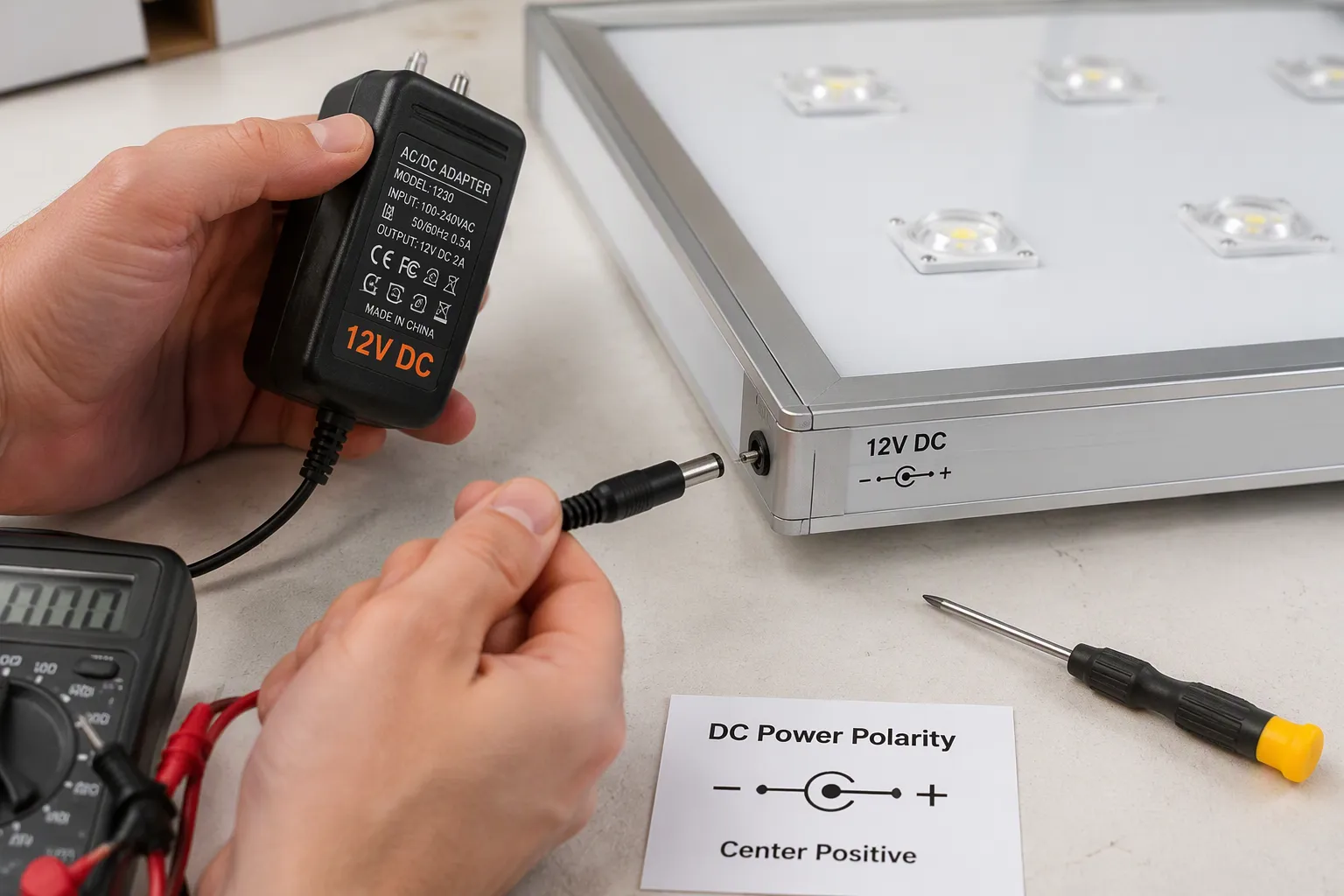
Not every adapter works with an LED lightbox. The adapter has to match the LED light's voltage and current needs. If it does not match, the modules may flicker, dim, or even break for good. Do these checks before you connect anything:
Check the polarity marks (+/−) from the strip through the connectors, the power supply, and the controller. Crossed wires often cause lights that will not turn on.
Match the strip's voltage label (12V or 24V) exactly to the power supply. Make sure the supply outputs DC constant voltage, not constant current.
Check that the total LED load does not go over the driver's wattage capacity. A power supply that is overloaded causes performance problems.
Voltage drop matters on large panels. Long LED matrix runs in thin SEG Lightbox frames cause clear color shift and dimming toward the far end of the run. A 24V DC module layout loses much less current over distance than a 12V DC setup, which cuts down on mismatch-related wear. Constant current IC technology on the module PCB also keeps color temperature even across the display, no matter where a module sits in the power chain.
Squeezing electronics into tight aluminum frame channels traps heat and raises electrical resistance. If you ignore thermal management and voltage drop, you get early color shifting, optical degradation, and LED failure in one spot.
When an Adapter Setup Fits
Plug standards differ by region, so international orders need the right plug type for each market. Certified external adapters make this easier. EXPOMAX holds CE certification, and the team provides installation videos and instructions that help dealers pick the correct adapter for each order.
An adapter setup works well in several situations. Retrofits often need a separate supply because the existing frame has no room for a built-in unit. Mixed installations benefit when some panels run on internal supplies and others need their own adapter. Suspended or modular setups also make wiring simpler with a separate power supply, since you can route cables panel by panel. An internal supply is still a clean choice for many standard units. The right pick depends on your frame layout and service access.
Battery Options for Cord-Free Lighting
How Battery Packs Work
A battery-powered SEG Lightbox works with no wires at all. A built-in rechargeable lithium-ion battery gives the LED modules the DC power they need. The pack links to matching connectors inside the lightbox through positive and negative terminals. You charge the unit, turn it on, and the graphic lights up with no cord in sight.
Setup is still easy. You can put the display anywhere in the venue, and no outlet limits your layout. The battery sits inside the frame, so the profile still looks clean from the front. Plan your charging time around the event schedule, because the pack needs a full charge before each use.
Runtime, Use Cases, and Cost
Runtime changes by model and by how you run the display. Published benchmarks give you a working range to plan around.
Benchmark | Value |
|---|---|
Charge time | 4–7 hours (some models 7–8 hours) |
Continuous runtime | 12–14 hours (alternate listing 15 hours) |
Recharge cycles | Approx. 1000 cycles (~2 years) |
Charging temperature | 0–45°C |
Discharge temperature | 20–45°C |
Market examples confirm this range. The SEGPRO Rechargeable LED Light Box Display Stand runs up to 14 hours, and the Displays2go battery-powered SEG lightbox runs up to 16 hours. Real runtime depends on panel size and brightness. A larger panel or a brighter setting uses more power and makes the run shorter.
Battery power fits temporary events, cord-free locations, and rental or pop-up displays. Plan around the limits. The pack lasts about 1000 cycles, or roughly two years of regular use, and you will replace it after that. Think of battery power as a partner to plug-in power, not a replacement. It solves the cord-free problem, and plug-in still wins for permanent spaces with outlets.
Choosing a Power Option for Your SEG Lightbox
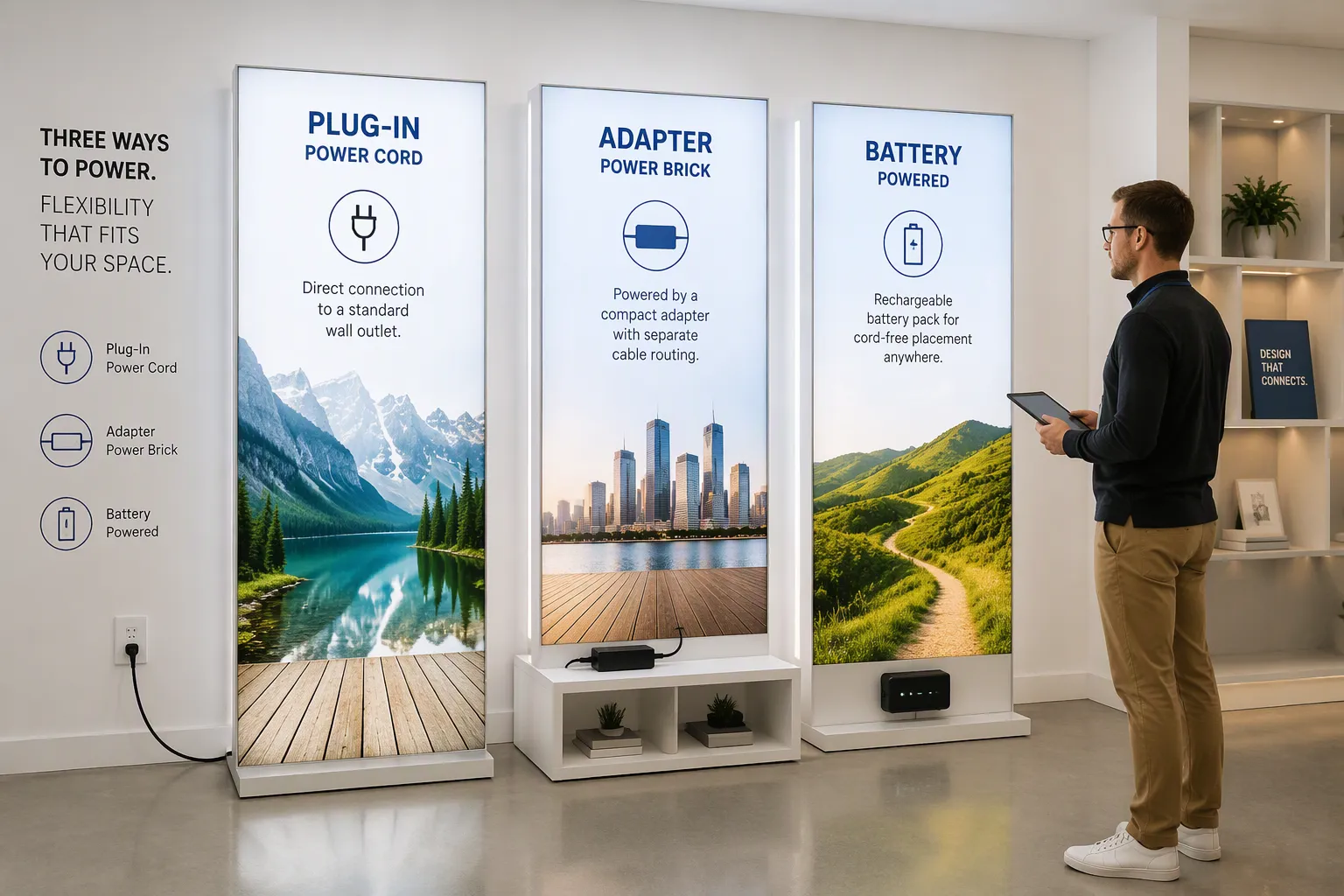
Scenario-Based Comparison
A quick recap helps you compare the three paths side by side.
Factor | Plug-In Power | Adapter Setup | Battery Pack |
|---|---|---|---|
Runtime | Unlimited while outlet power lasts | Unlimited while outlet power lasts | About 12–16 hours per charge, depending on the model |
Installation flexibility | Fixed to outlet location | Flexible wiring for retrofits and modular frames | Fully cord-free placement |
Compliance | CE, UL, RoHS on SEGQUICK units | CE-certified adapters available | Check the marks on the pack |
Cost profile | Lowest ongoing cost | Moderate, adapter priced separately | Highest, with replacement packs over time |
Now match the option to your project. A permanent retail store or showroom points to plug-in power. The display stays put, an outlet sits nearby, and you never deal with a charge cycle. A retrofit or a modular booth with mixed power needs points to an adapter setup. You can route a separate supply panel by panel and swap a failed brick without opening the frame. A temporary event or a cord-free spot points to battery power. You place the unit anywhere in the hall and skip the outlet hunt entirely.
Specs to Confirm Before Ordering
Start with the electrical basics. Confirm the voltage and current the LED modules draw, and match the adapter to both. Check the wattage per panel, since power consumption options run at 8 W and 15 W, with LED strips drawing 4.5 W each. For early electrical planning, estimate load with power density of roughly 50–120 W/m². A 7.5 m² wall at 80 W/m² comes to about 600 W of lighting load, which tells you what the venue circuit must carry.
Then confirm the physical details. Ask for the adapter plug type for your market, plus battery runtime and charge time if you choose a cord-free unit. Verify the certification marks your region requires: CE, UL, ISO, and RoHS.
Two lighting choices also affect the quote. Half-Lit units place LED strips on two sides and give dimmer, less even light. Full-Lit units run strips on all four sides for brighter, more even output. Larger sizes increase the distance light must travel, so size and brightness together decide which one you need. Single-sided and double-sided builds change brightness per side as well.
Check the EXPOMAX SEGQUICK Lightbox parameters for exact figures, then contact the team for dealer pricing and support.
Plug-in power, adapters, and battery packs each fix a different problem. Your choice depends on how permanent the setup is, where it sits, and your budget. A permanent retail wall works best with plug-in power. A retrofit or mixed booth setup works best with an adapter setup. A cord-free or temporary display works best with battery power. Before you order, confirm the exact voltage, wattage, and battery runtime with your supplier. Check the EXPOMAX SEGQUICK Lightbox parameters for these figures. Then contact the team for dealer pricing and support on your next SEG Lightbox project.
FAQ
Does every SEG Lightbox need a wall outlet?
No. Plug-in models need an outlet, but battery-powered units run without a cord. Adapter setups still get power from a socket through a separate power supply. Match the power path to your location before you order.
Can I switch a lightbox from plug-in to battery power later?
Sometimes. The frame must have room for a battery pack and matching connectors. Ask your supplier about the inside layout first. Retrofits differ by model, so confirm the fit before you buy.
What happens if I use the wrong adapter voltage?
The LEDs may flicker, dim, or stop working for good. Match the adapter to the module's voltage and current exactly. Check the polarity marks too. A mismatched supply can damage the modules beyond repair.
How long does a battery charge last?
Published benchmarks list about 12–16 hours of continuous runtime per charge. Larger panels and brighter settings make that run shorter. Plan a full recharge before each event, since charge time takes several hours.
Do SEGQUICK lightboxes meet international safety standards?
Yes. The SEGQUICK Lightbox holds CE, UL, ISO, and RoHS certification. Confirm the marks your region requires before ordering. Certified external adapters also make international orders with different plug types easier.





View More(Total0)Comment lists